Coding with AI : Beyond Autocomplete - The Big Picture
"Rewiring the Nervous System of Software Engineering with AI Agents"
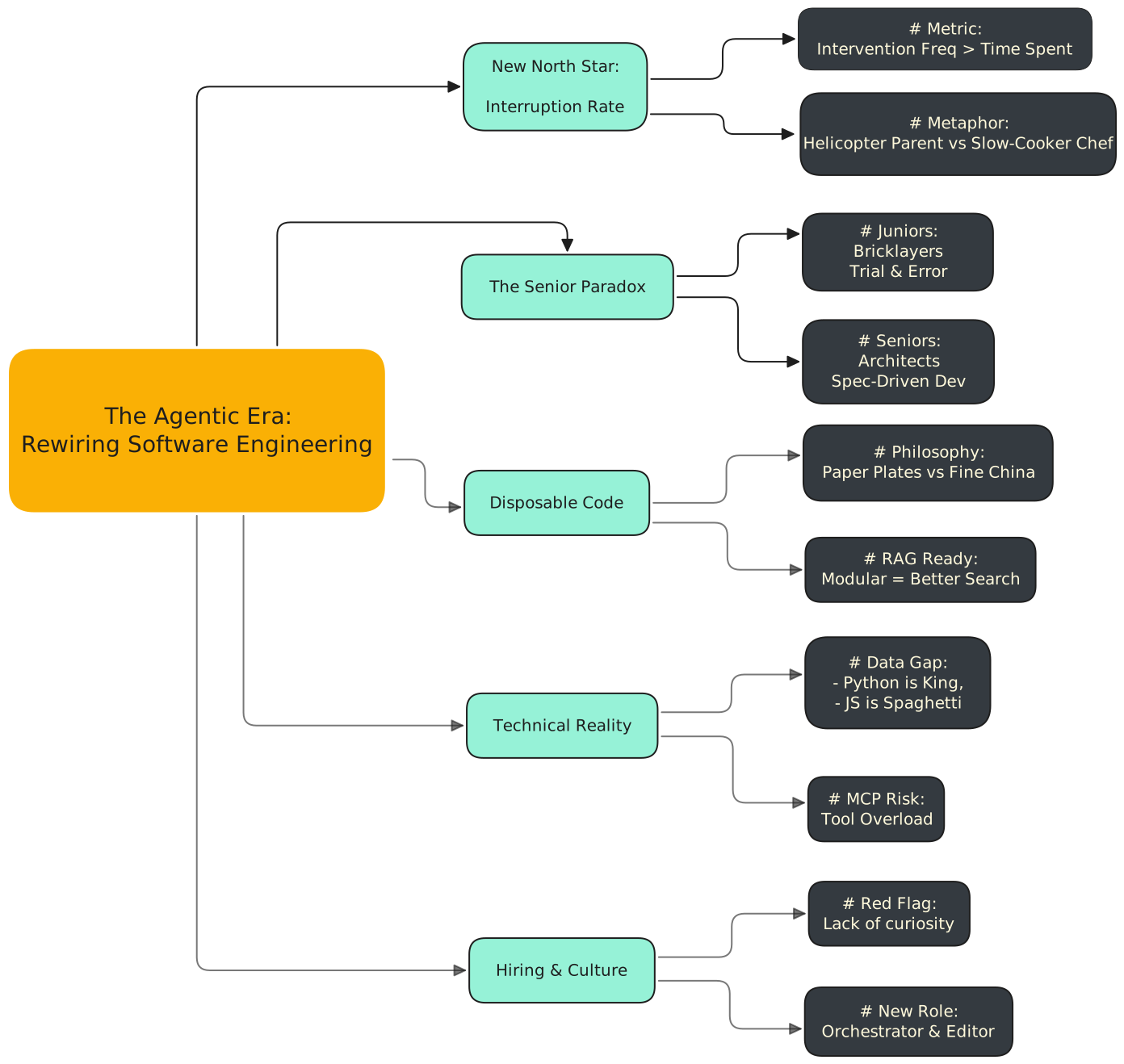
If you are a software engineer and you haven't experimented with AI coding tools yet, you might want to start. In a recent conversation with industry leaders, a hiring manager dropped a stark reality check: If a candidate hasn't experimented with AI coding, it’s a red flag. It signals a lack of curiosity and an unwillingness to adapt.
But "coding with AI" has moved far beyond the simple autocomplete suggestions of 2021. We are entering the Agentic Era. We aren't just using AI to write a for loop; we are designing autonomous agents that plan, reason, and adapt.
This shift is fundamentally rewriting the rules of software development—changing our metrics, our workflows, and even the definition of what it means to be "senior."
The Death of "Lines of Code" and "Engineering Hours"
For decades, we measured productivity with industrial metrics: How many lines of code did you ship? How many engineering hours did this feature take?
In the age of AI, these metrics are obsolete.
Chip Huyen notes in one recent talk, Engineering Time is no longer equal to Mental Energy.
Imagine two scenarios:
The Helicopter Parent: You spend 8 hours "coding" with an AI, but you have to babysit it constantly, fixing syntax errors and guiding every step. You are exhausted.
The Slow-Cooker Chef: You spend 30 minutes writing a detailed spec, hand it to an autonomous agent, and walk away. You come back 8 hours later to a finished feature.
Both tasks took "8 hours" of elapsed time. But the mental energy required for the second was negligible. This allows engineers to parallel process—spinning up 20 agents to tackle 20 tasks while they sleep.
The Concurrency Trap: Atomic Execution
The Reality: Agents operate on a Plan → Execute → Verify loop. When a Main Agent dispatches a task to a Sub-Agent, the execution is often atomic—meaning the UI locks until the Sub-Agent returns.
The Risk: If a sub-agent enters a hallucination loop, you burn tokens without feedback.
Example: A TestRunner sub-agent gets stuck debugging a flaky test for 10 minutes while the Main Agent (and you) sits idle.
The Shift: We are moving from measuring output volume to measuring autonomous reliability.
The New North Star: Interruption Rate
If we can't use "time spent" as a metric, what do we use? The industry is borrowing a concept from the autonomous vehicle industry: The Interruption Rate (or Intervention Rate).
In self-driving cars, we measure how many miles the car can drive before a human has to grab the steering wheel in a panic. Graham Neubig, a professor at CMU and creator at All Hands AI, applies this to coding: How many steps can the agent take before the human has to intervene?
Level 1 (Autocomplete): The AI suggests the next word. (High interruption).
Level 3 (Conditional Automation): The AI builds a feature but needs help with integration.
Level 5 (Full Automation): The AI takes a Jira ticket and submits a valid Pull Request without you looking.
Currently, most tools sit between Level 2 and 3. The goal of modern AI engineering is to reduce that interruption rate. If you have to grab the wheel every 10 minutes, the car isn't autonomous—it's just a Student Driver that you can't trust.
The "Monkey See, Monkey Do" Problem: Why AI Fails at JavaScript
Not all languages are created equal in the eyes of an LLM. When testing agent performance, a curious pattern emerges: AI is significantly better at Python than it is at JavaScript.
Why? It comes down to the "Monkey See, Monkey Do" nature of Large Language Models.
Models are trained on the internet. The Python community, largely driven by data science and academia, tends to enforce strict structure and readability. The JavaScript ecosystem, however, is the Wild West. The internet is flooded with "spaghetti code," bad practices, and ten-year-old frameworks.
When the AI trains on this data, it mimics it. It’s like a parrot learning to speak by listening to toddlers—it picks up the bad grammar along with the good. This aligns with findings from papers like StarCoder: May the Source Be With You, which highlights how the quality and volume of training data (The Stack) dictate model competence.
The "Cuda Wall": Data Scarcity
The Reality: Agent performance is strictly bound by the volume of high-quality training data available in "The Stack."
The Gap: Agents excel at Python (high volume, high quality) but fail at Cuda/Kernel optimization (low volume, high complexity).
Takeaway: For low-level systems code, the AI is still just a fancy autocomplete (Level 1), not an autonomous agent (Level 5).
The "Senior Paradox": Who Interrupts More?
There is a prevailing fear that AI will replace junior engineers, leaving no path for new talent. However, the data on Interruption Rates reveals a paradox.
You might assume Senior Engineers—who know the code best—would micromanage the AI, interrupting it constantly. In reality, Senior Engineers interrupt the AI less than Juniors.
The Architect vs. The Bricklayer
Junior Engineers often jump straight into execution. They give the AI a vague prompt ("Make me a website"), watch it fail, interrupt it, change the prompt, and get stuck in a loop of trial and error.
Senior Engineers practice Spec-Driven Development. They act as Architects. They write a detailed design document, define the constraints, specify the tech stack, and then unleash the agent.
Because the instructions are clear, the agent has a straight path to the solution. The Senior Engineer has effectively "prompt engineered" the system architecture, not just the text.
Takeaway: The most valuable skill for the future isn't syntax; it's System Thinking. It’s the ability to articulate what needs to be built so clearly that even a machine can’t mess it up.
Disposable Code: Paper Plates vs. Fine China
We used to treat code like family silver. We polished it, refactored it, and protected it. We wrote it by hand, so we were emotionally attached to it.
With AI, code is becoming disposable.
If a feature is buggy, we no longer painstakingly debug it line by line. We treat it like a paper plate—we throw it in the trash and ask the AI to generate a fresh one from scratch. This shift from "repairing" to "regenerating" changes how we view technical debt. It encourages modularity because AI struggles to navigate massive, monolithic codebases (the "Context Window" limit).
To make your codebase "AI Ready," you need to stop building tangled webs of dependencies. You need small, isolated components that an AI can read, understand, and rewrite without breaking the whole system.
Refactoring for RAG
The Reality: We are entering an era where code must be readable by machines, not just humans. In messy codebases, an agent's "Search Steps" increase super-linearly (graph traversal complexity).
The Fix: Optimize for Semantic Retrievability.
Example: An agent takes 15 steps to find a definition in a 5,000-line monolithic
utils.jsfile, but only 2 steps in a strictly typed, modular directory structure.
The Trap of Tool Overload
Finally, a word of caution on the tools themselves. With standards like MCP (Model Context Protocol), it is easy to give an agent access to your calendar, your email, your database, and your slack.
But giving an agent 20 different tools is like handling a Swiss Army Knife with 50 blades to someone wearing mittens—they will likely just fumble and cut themselves.
Current research suggests that agent performance degrades when the "action space" (the number of tools available) becomes too large. The agent gets confused about which tool to use. Effective AI engineering involves curating a small, highly specific toolbox for the agent to ensure reliability.
The "God Agent" Anti-Pattern
The Reality: With the Model Context Protocol (MCP), it's tempting to give an agent access to every tool (Database, Slack, GitHub). This causes Action Space Explosion—too many choices degrade model reasoning.
The Fix: Use Scoped Agents with limited tools arrays.
Example: Instead of one "DevBot" with 50 tools, create a RefactorBot (only read/write files) and a DeployBot (only git/aws access).
Conclusion: The Human in the Loop
We are moving toward a future where engineers spend less time writing code and more time reviewing it. We are becoming editors, architects, and orchestrators. "Prompt Engineering is not going away, because Prompt Engineering is just communication." As long as we need to translate human intent into machine execution, the ability to communicate clearly; to write the spec, to define the constraint, to guide the agent; will remain the defining skill of the elite engineer.
Review: Coding with AI : Beyond Autocomplete - The Big Picture
Further Reading & References
- Graham Neubig (CMU/All Hands): On "Intervention/Interruption Rates" as a primary metric for agentic success.
- SWE-bench (Princeton/UChicago): The industry standard benchmark for evaluating how well LLMs can solve real-world GitHub issues (moving from Level 1 to Level 3 automation).
- The "StarCoder" Paper (HuggingFace/BigCode): For a deep dive into how training data composition impacts coding performance across different languages (Python vs. JS).
- Principles of Least Effort: Referencing George Kingsley Zipf’s principle, applied here to developer tool selection (CLI vs IDE).
- Coding with AI talk by Chip Huyen at Pytorch Conference 2025 coding-with-ai-chip-huyen